What does a typical Japanese kitchen look like?
A typical Japanese kitchen is small and often in one straight line: sink, counter, and a gas or induction cooktop with a fish-grill drawer. A rice cooker and an oven-microwave stand nearby; about 37% of households of two or more have a dishwasher.
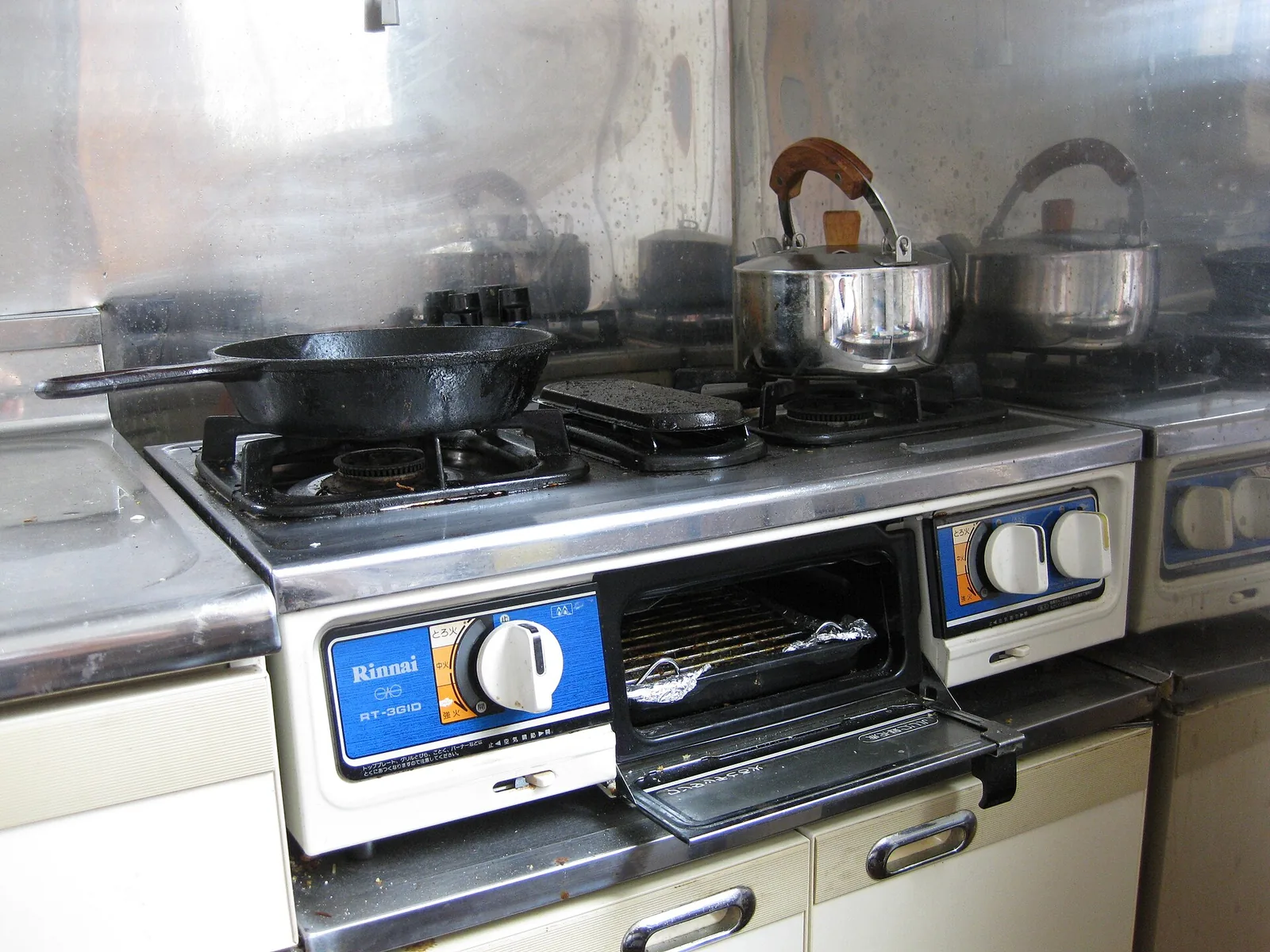
A typical Japanese kitchen is small and often laid out in one line: sink, a strip of counter and a gas or induction cooktop, with a grill drawer in front for fish. Nearby stand a rice cooker and an oven-microwave, and about 37% of households of two or more have a dishwasher.
The drawer under the burners
The cover photo shows a two-burner gas stove with its grill drawer pulled open. On a typical induction cooktop, Mitsubishi Electric's engineers write, three cooking zones sit on top and the grill sits in front.
The grill is built for fish. In a leaflet published by the Fisheries Agency, gas-appliance maker Paloma explains that the inside of its grill goes above 400°C and cooks both sides at once, so nobody has to turn the fish. Its waterless grill, it adds, cuts the gas bill by about 30% compared with grills that need water in the tray.
Not every drawer gets opened. In a 2019 Noritz survey of 421 married women with children in the Tokyo area, about 1 in 5 had not used the grill in the past year, and more than half of those said cleaning it was too much trouble. Mitsubishi Electric's engineers also describe the built-in grill as one used less and less for fish.
Gas or induction
New kitchens are split. Figures from the Kitchen Bath Industry Association, quoted by Mitsubishi Electric, show that in 2016 gas was built into 49% of new kitchens and induction (IH) into 29%; the rest shipped without a built-in cooktop. In 2010 it had been the other way round, IH 40% and gas 39%, before IH fell back after 2011.
Across all homes, a 2024 Mitsubishi Research Institute survey found built-in IH in 39.0% of detached houses and 21.4% of flats, 30.6% overall.
People who chose gas give plain reasons. In a Mitsubishi Electric survey of 700 people who had put in a gas cooktop, the top two reasons were "I'm used to it" (49.1%) and price (39.5%). Panasonic, which makes induction cooktops, asked gas users what they thought of IH: 59.0% believed its heat is weak and 61.0% that many pots and pans don't work on it. Panasonic calls both beliefs mistaken.
Small, in a line, facing the table
Kitchens have been getting smaller. Noritz wrote in 2019 that kitchens are shrinking to make room for the living-dining area, and that year it launched its first stove 30 cm wide, with two burners and no grill, for one-person rental flats.
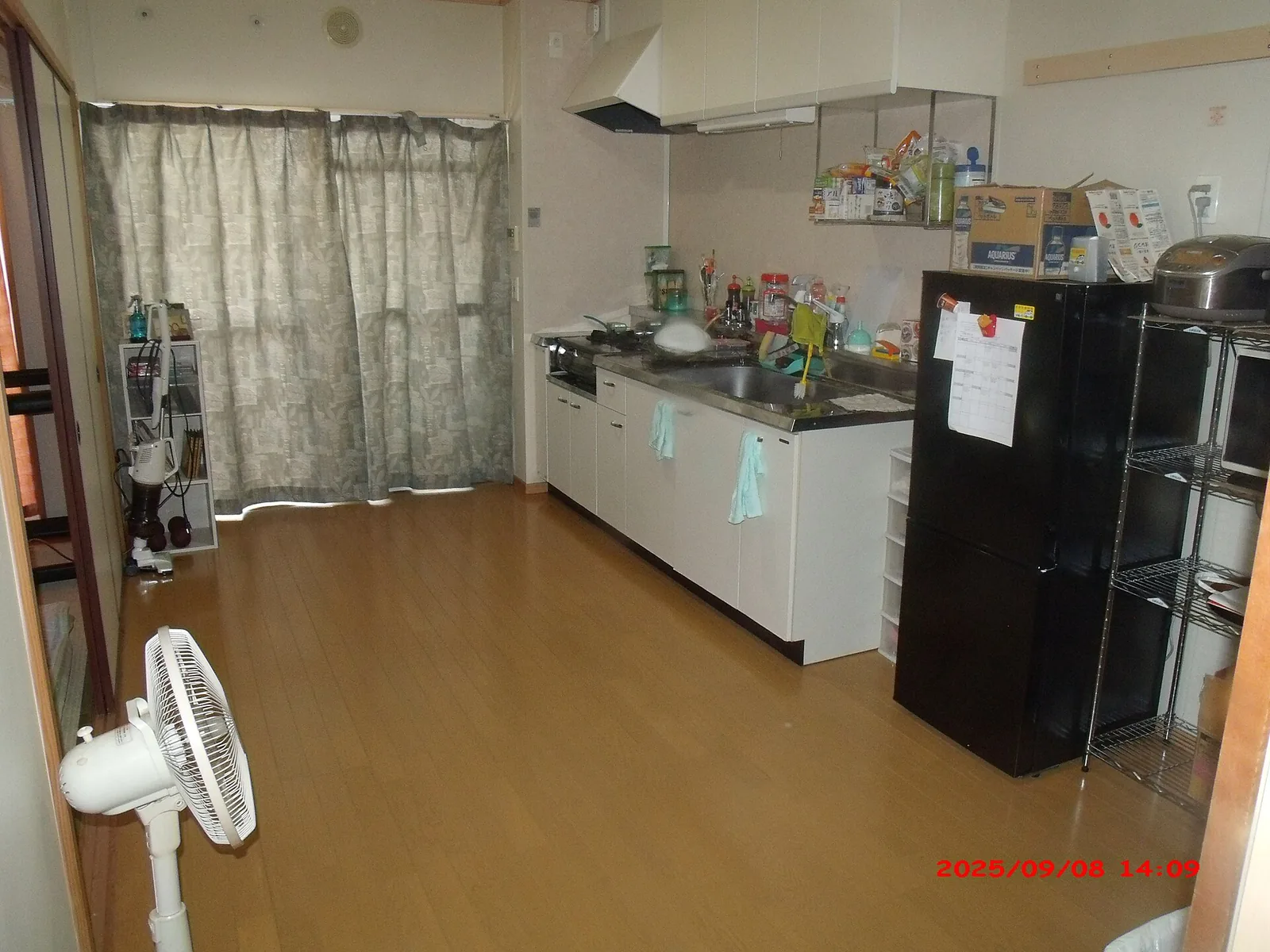
The I-shaped kitchen puts the sink, counter and stove in one straight line, like the public-housing flat in Higashi-Osaka above. A taimen kitchen turns that line to face the dining room, so the cook can talk with the family while working.
How much room there is shapes the choice. Promoting its own kitchen in 2024, Panasonic quoted an architect saying typical homes could only fit a 2,550 mm I-shaped taimen kitchen. The same release surveyed 300 women in cities: they walked between kitchen and table 8 times on average over a meal, about 30% ten times or more, and 72% had had their own meal go cold while they served or cooked.
The stainless sink is younger than it looks: it was first installed in the dining kitchens of the Harumi danchi in the 1950s, a Japan Housing Corporation estate in Tokyo, and spread to ordinary homes from there.
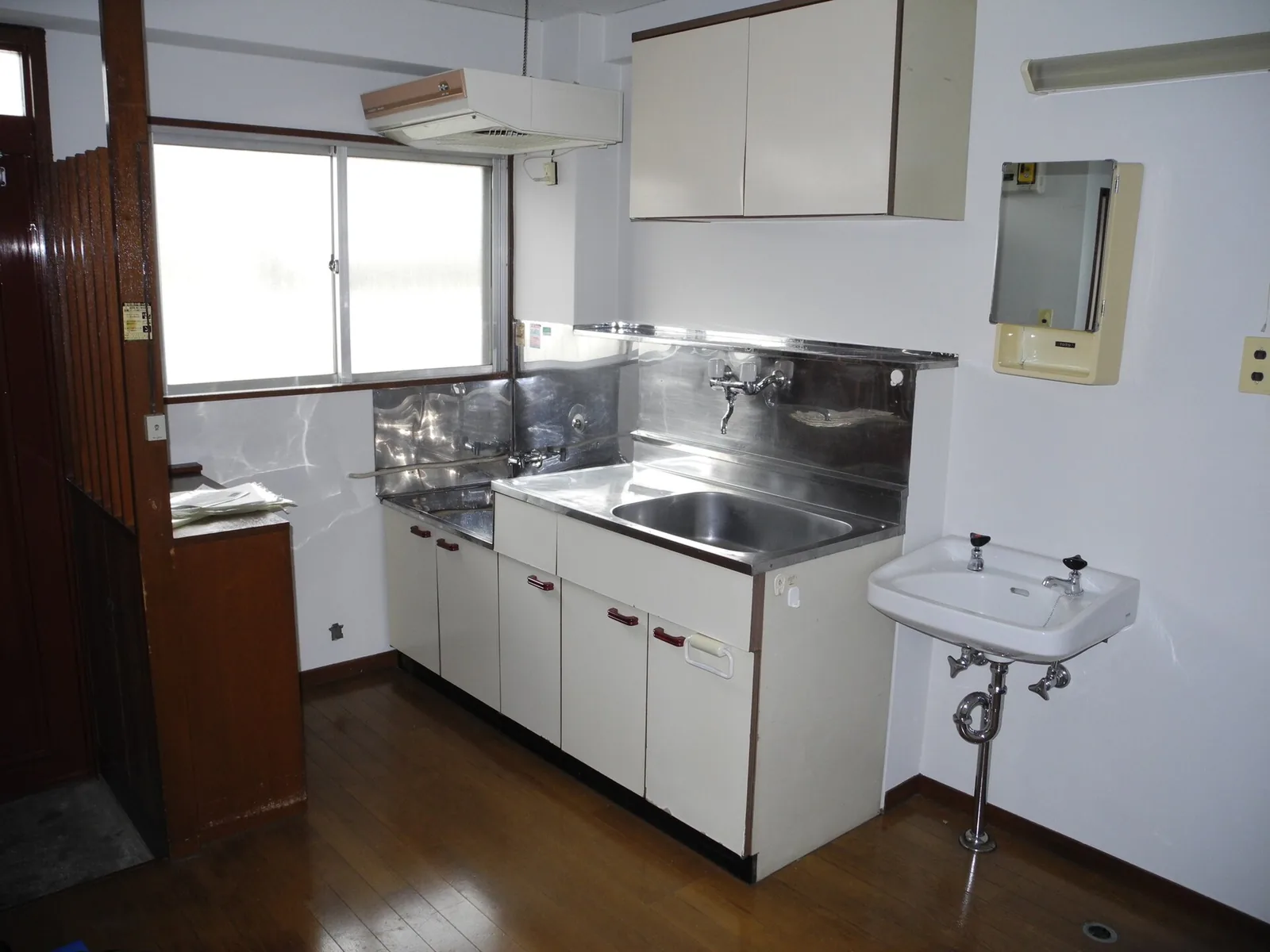
The term "system kitchen" began in 1973 as the proper name of a prototype German-style kitchen in Cleanup's showroom; the Japan Patent Attorneys Association now calls it a form of kitchen specific to Japan. The same association gives a rule for the counter: half your height plus 5 cm, so a person 160 cm tall gets a counter 85 cm high.
The rice cooker and the oven-microwave
The rice cooker is the one appliance nearly everyone has. In a 2024 LY Corporation survey of 5,255 people, nearly 90% of those who eat rice at home make it in a rice cooker, which, nippon.com notes, means almost every household has one. The electric rice cooker has been around since 1955, and the first one heated by induction came in 1992.
In GfK Japan's 2024 survey, rice cookers and fridges are in more than 80% of homes, and the oven-microwave in more than half. Young people living alone in 2009 were already equipped: the Statistics Bureau counted a rice cooker in about 70% of single households under 30, and a microwave in 82.1% of the men's homes and 92.9% of the women's. Many new fridges are large: of the 3.416 million shipped in 2025, about 40% held 401 litres or more.
Why so few dishwashers
Most families have no dishwasher. The Cabinet Office's consumer survey of March 2024 put dishwashers in 37.3% of households of two or more, up from 21.6% in 2005, against about 70% in Europe and the US. GfK's count of built-in dishwashers alone was 21%.
The biggest reason, President Online writes, is the same now as it always was: the kitchen is too small.
The panel on the wall
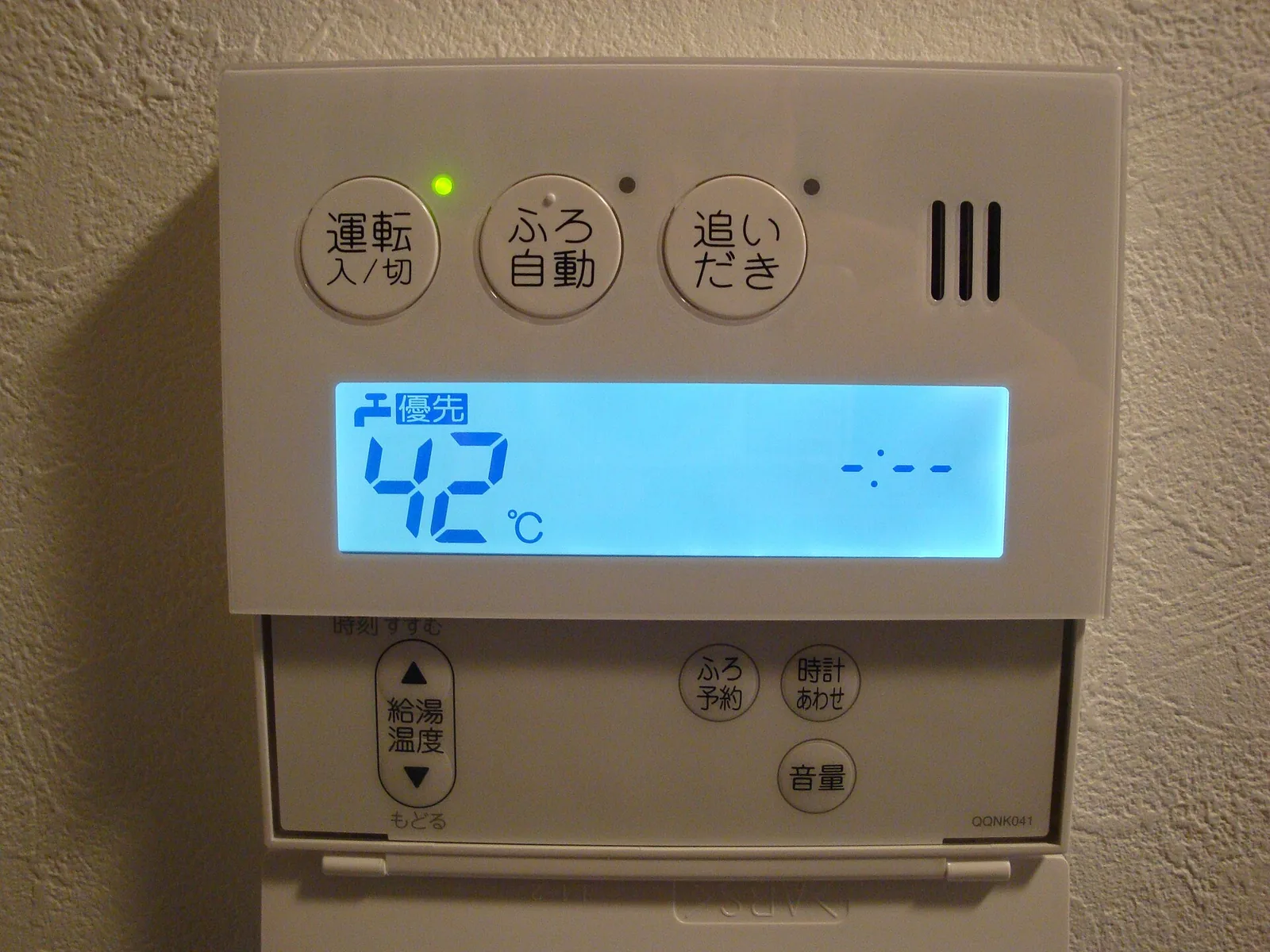
In homes with this kind of water heater, a small panel sits on the kitchen wall. In one Hitachi manual, the hot-water temperature can be set from both the kitchen remote and the bath remote, and when the tub is full a voice announces "O-furo ga wakimashita": the bath is ready. Why the bath matters so much is in peeka's piece on the Japanese house.
From the stove to the table, and to school
Some of what is cooked here leaves the kitchen in the pot it was made in, or in a box. The donabe, an earthenware pot, goes straight to the table as the serving dish. The pot that stays behind is the yukihira saucepan, which nippon.com calls "possibly the most used pan in the Japanese kitchen".
The box is the bento. Among high school students who bring one for lunch, 92.4% said a parent made it.
Where the scraps go
The kitchen bin follows the city's rules. Each municipality sets its own, and kitchen waste usually goes out as burnable garbage. The number of categories changes at the city line: a 2021 Environment Ministry report counted 496 of Japan's 1,719 municipalities sorting into 10 or fewer, and 638 using 11 to 15. The town of Kamikatsu uses 44.
What does your kitchen look like?
Everything above comes from industry reports, government surveys and makers' own studies, so it is a sketch from the outside. It cannot show the difference between a one-room rental in Tokyo with a 30 cm stove and a family house in the countryside, or what your family keeps in the fish-grill drawer.
If you live in Japan, or grew up in a Japanese home: what did this miss? Gas or IH at your place? Does the grill get used, and for what? Who cooks on weekday nights, and who packs the bento? How many bins sit in your kitchen? Corrections and additions are welcome, and good ones will be added to this page, with your permission and credit.
Which appliance in your kitchen could you not do without?
On peeka you pick a question and answer it with a photo. See how people around the world answer, and add yours.

Can't wait? Join the iPhone beta on TestFlight.