What do Moroccans eat for breakfast?
Many Moroccans start the day with bread, harcha or msemen, with olive oil, butter, cheese or honey, and mint tea or milky coffee. Here is what each one is, where bissara, sfenj and amlou fit, and how Ramadan changes the table.
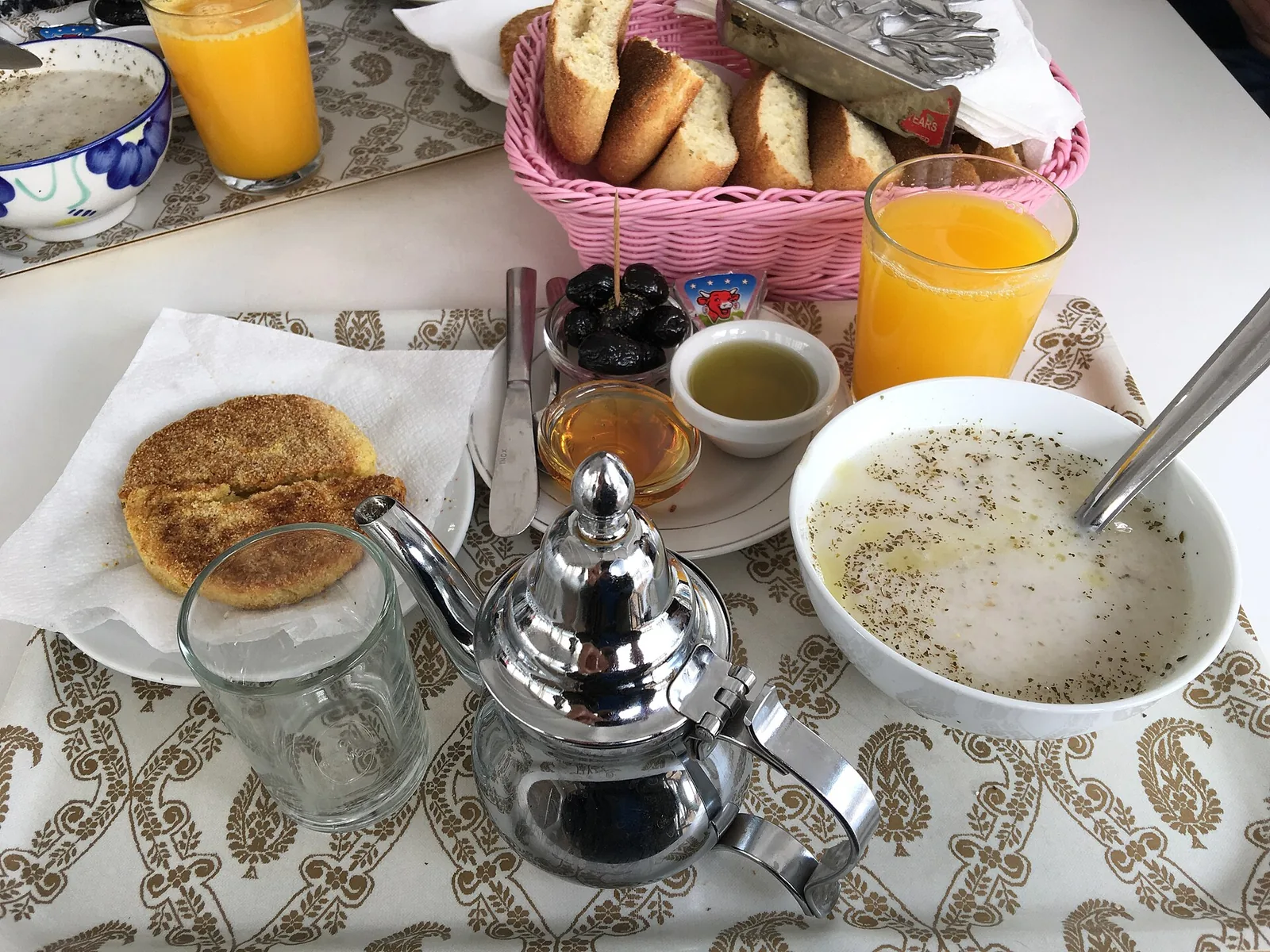
For breakfast, many Moroccans eat bread, harcha (semolina griddle cakes) or msemen (oiled pancakes). On top go butter, soft cheese, honey or olive oil, and next to it a glass of mint tea or coffee with milk. On cold mornings there may be a bowl of bissara from a café or a market stall; in Ramadan, much of it moves to the meal at sunset.
The table on the cover was photographed in Casablanca at a quarter to eleven one April morning: harcha, a semolina soup, olives, olive oil, honey, bread, orange juice and a pot of tea.
Bread first
Writing for Morocco World News, Clay and Ann Smith put it simply: bread is very often the center of a traditional Moroccan breakfast, and Moroccans eat bread with all three traditional meals of the day.
The same piece says that until the 1980s almost all Moroccan women made their own bread, sometimes twice a day. The dough went to the neighbourhood's communal oven, and it was, and still is, common for a child to carry it there, often on his or her head. Home ovens have taken over much of that work, but most communities still have a communal oven that works.
Who bakes depends a lot on where you live. The national household consumption survey of 2014 found that people in cities eat almost eight times more bought bread than people in the countryside: 29.6 kg against 3.8 kg per person per year. Across the country, flour makes up 62.6% of all cereals consumed, and bought bread 10.4%.
Some mornings start outside the home, with sfenj from a vendor or bissara from a café, both further down. Eating out in general is growing: figures from the planning commission, reported by Hespress, show that the share of the food budget spent on meals eaten out doubled between 2014 and 2022. The figure covers all meals, not breakfast alone.
Msemen, harcha and baghrir
Next to the round loaf come the griddle breads. Msemen is dough folded into a square with many thin layers inside and cooked on a griddle. It can also be stuffed, with khlea (preserved meat) or with onion and tomato.
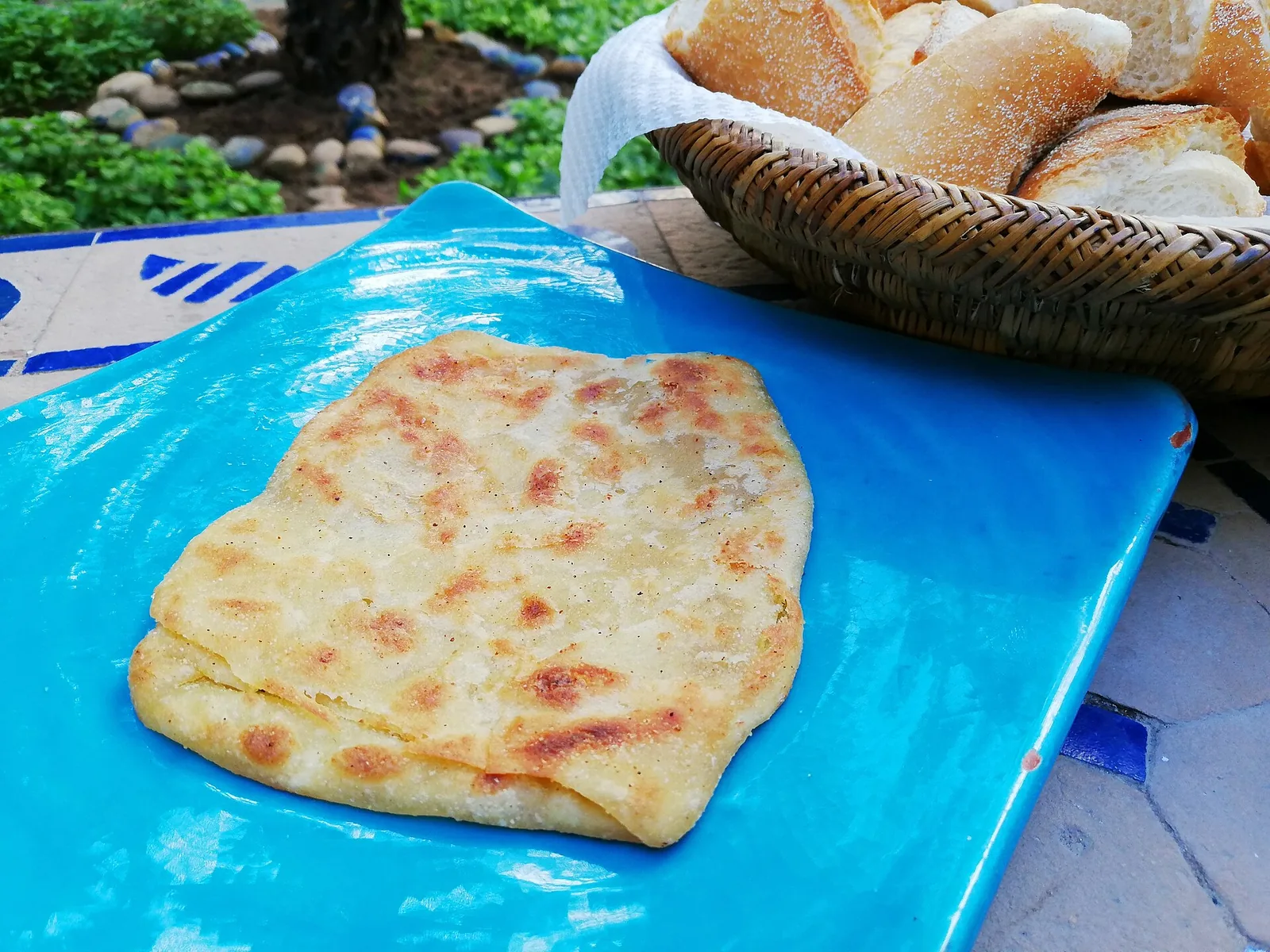
Morocco World News describes msemen eaten with honey, butter or soft cheese, or already spread and rolled up for a grab-and-go breakfast, with mint tea or milky coffee alongside.
Harcha is a semolina flatbread cooked on a griddle or in a pan, from the Middle Atlas. It is also one of the breads people eat during Ramadan.
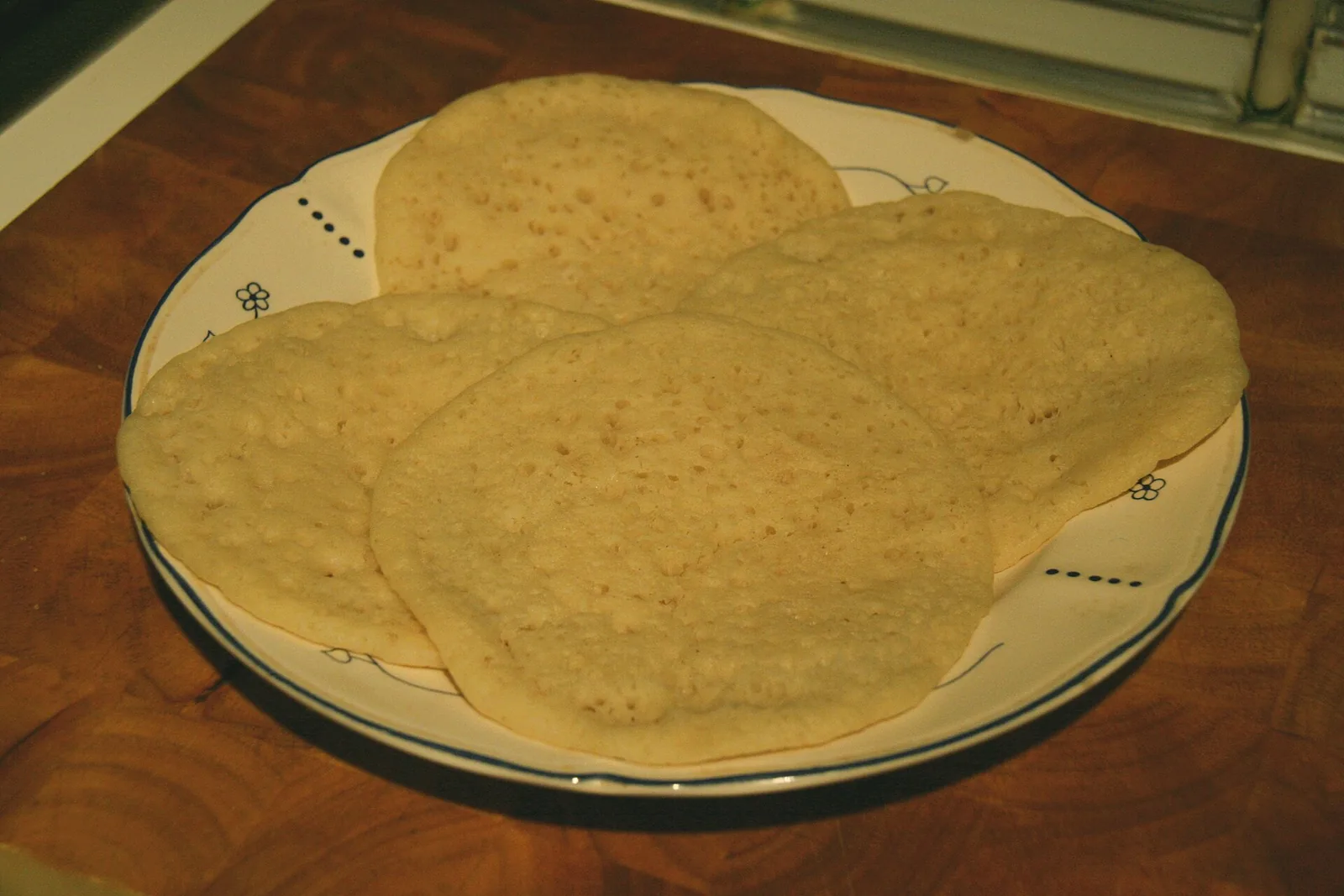
Baghrir is the soft one. It is spongy and riddled with tiny holes that soak up whatever is poured over it, and it is eaten for breakfast, as a snack, and at iftar during Ramadan.
Sfenj, from the vendor
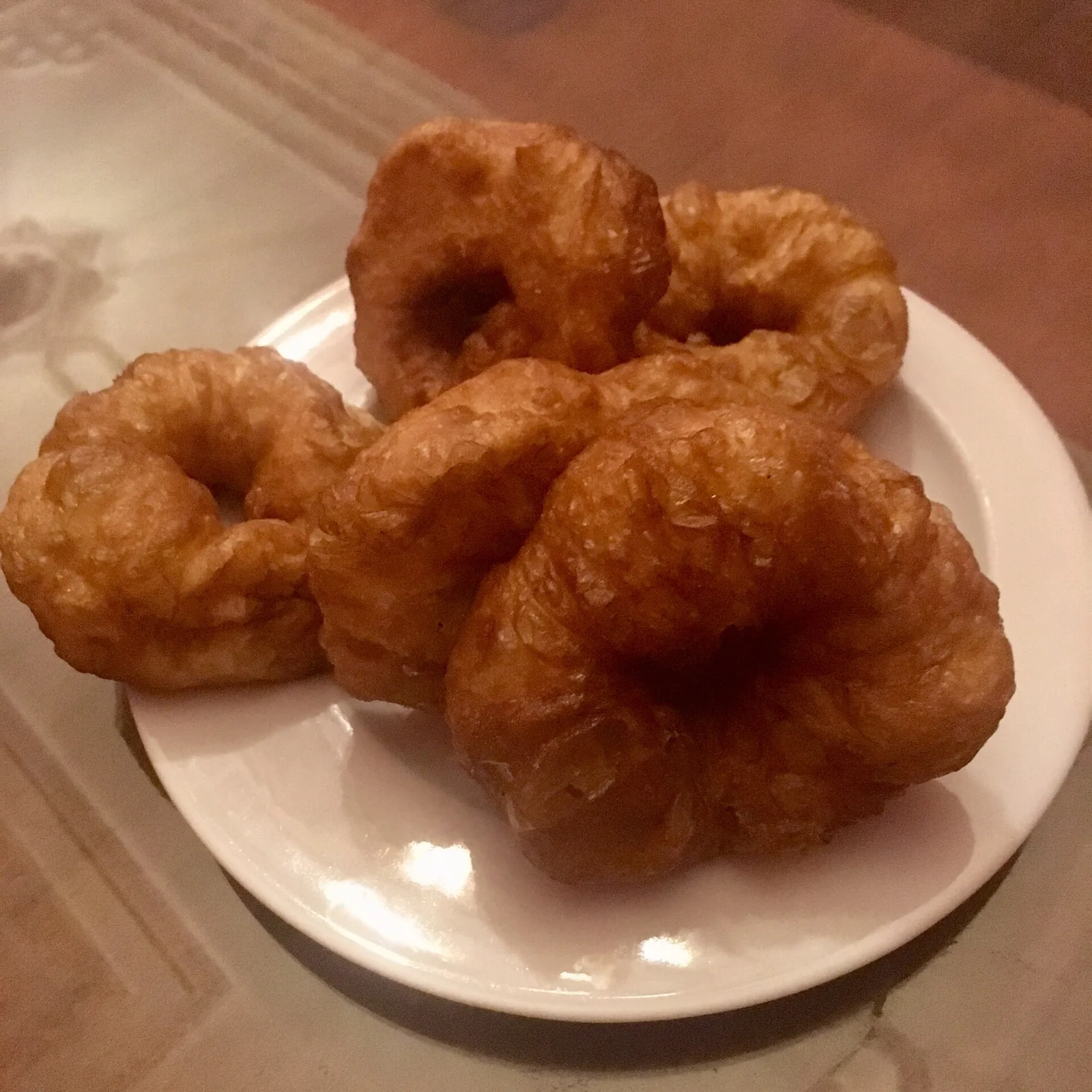
Some breakfast is not made at home at all. Sfenj are rings of fried dough, traditionally made and sold early in the morning for breakfast. Morocco World News writes that families pick them up from local vendors early, and that homemade sfenj is a rarity.
Olive oil, jben, amlou and honey
What goes on the bread changes with the region and the household.
Olive oil is on more tables than before. The 2014 survey found that each person used 6.9 litres of olive oil a year, up from 3.49 litres in 2001, though ordinary table oil was still far ahead at 15.4 litres. In the countryside, the amount of farm butter people ate rose by about two thirds over the same years, from 0.66 kg to 1.1 kg a year.
In the north, around Chefchaouen, there is jben, a fresh goat's cheese. Slow Food's Ark of Taste notes that goat's jben is eaten for breakfast, sometimes with olive oil, and that it is made mainly by families, so very little of it is produced.
In the Souss, in the south-west, the spread is amlou: almonds, argan oil and honey. It is usually served for breakfast or afternoon tea with pancakes and pastries. In a study of argan work, Huang writes that the Amazigh (Berber) women who press argan oil at home may also use their millstones to mix argan oil, honey and almonds into amlou.
The know-how around the argan tree, which grows in the Arganeraie Biosphere Reserve in south-west Morocco, was inscribed by UNESCO in 2014. The women who work with argan teach it to their daughters from a young age.
Honey shows up on the cover table; across a whole year, though, the survey found that average honey consumption stays very low, 0.55 kg per person a year, and about three quarters of it is industrial honey.
Something warmer: bissara, khlea and eggs
When cold mornings come, cafés and market stalls bring out wide pots of bissara, served with olive oil, cumin and pepper. Many Moroccans link it with the north.
Khlea is dried, spiced meat kept in fat. It can be stored for up to two years at room temperature. Morocco World News says it is traditionally made right after Eid al-Adha and pairs well with crispy fried eggs.
Eggs in general are eaten far more than before: 103 per person in 2014, up from 65 in 2001, with people in cities eating 122 and rural people 74.
Tea, or nouss-nouss
The glass next to the bread is often tea. In the countryside, people drank 2.73 kg of tea per person in 2014, against 1.86 kg in 2001. In the cities, coffee stayed flat while tea rose. Across the country it came to 2.38 kg of tea and 1.01 kg of coffee per person a year.
The sugar often comes as a cone. More than half of all sugar (56%) is bought as a sugar loaf, and in the countryside the share is 70.6%.
For those who take coffee at a café, there are words for it. Nouss-nouss means “half-half” in Darija, and a black coffee is a normale.
In Ramadan
During Ramadan, several of these breakfast foods move to the meal that breaks the fast at sunset, which Moroccans call ftour. National Geographic describes it built around harira soup, hard-boiled eggs dipped in cumin, and chebakia, honeyed, flower-shaped cookies with sesame seeds.
Msemen comes back here too. Morocco World News lists it among the essential ftour foods: “Without it, the ftour table is incomplete.” Before dawn, the meal is smaller. In many Sahrawi homes, suhoor is simpler than ftour: dates, tea and dairy.
What is missing at your table?
This is a first sketch, put together from Morocco's 2014 household consumption survey, Moroccan news sites, food writers and reference works. The survey counts what households eat in a year, not what they eat at breakfast, and nothing here comes from a Moroccan kitchen directly. Breakfast in Tangier is not breakfast in Agadir or in a village in the Middle Atlas, and two families on the same street can set two different tables.
If you grew up in Morocco, or cook for a Moroccan household now: what did this leave out? Is your bread from the bakery, from your own oven, or still from the communal one? Do you call it msemen, rghaif or something else? Is amlou an everyday thing at your house, or something you bring back from the south? Corrections and additions are welcome, and good ones will be added to this page, with your permission and credit.
Where does the bread on your table come from?
On peeka you pick a question and answer it with a photo. See how people around the world answer, and add yours.

Can't wait? Join the iPhone beta on TestFlight.