What do Iranians eat for breakfast?
An Iranian breakfast usually starts with fresh flatbread, white cheese and sweet black tea. Which bread goes with which topping, how the tea is sweetened, and the hot winter bowls: adasi, haleem and kaleh pacheh.
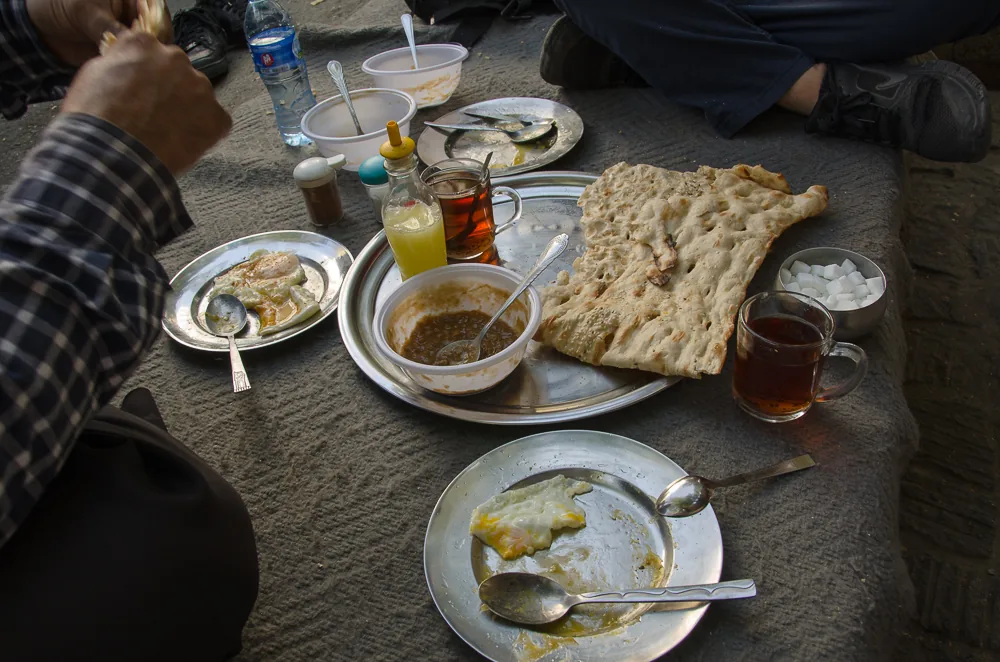
The everyday Iranian breakfast is fresh flatbread, a piece of white cheese and a glass of sweet black tea. Reporting from a Tehran bakery, AFP describes a freshly baked flatbread with feta and sweet tea as the usual pairing. Around that core, many families add walnuts, herbs, butter, jam or honey, eggs, and in winter a hot bowl of lentils, porridge or broth.
Which bread, which topping and which hot dish all depend on the house and the city.
Bread first, from the bakery
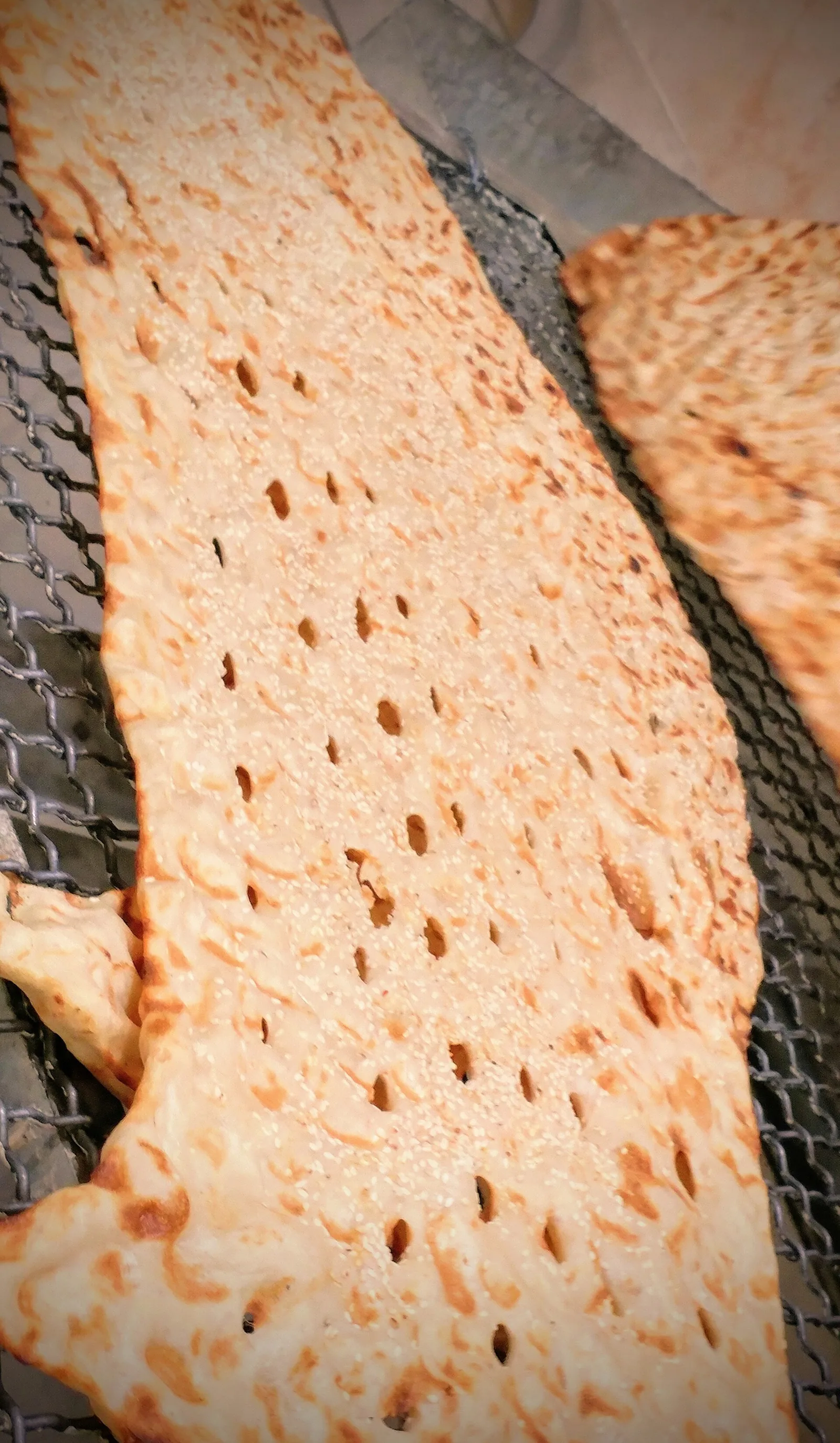
The day starts at the bakery. In the same AFP piece, Tehran's bakers "get up well before the crack of dawn". Of the four main traditional breads, barbari, lavash, sangak and taftoon, AFP calls sangak the most popular, "seen as Iran's national bread". According to the same AFP report, the health ministry said in January 2020 that Iranians eat on average 310 grams of bread a day.
Sangak is baked on a bed of small river stones in an oven. It was first mentioned in the 11th century. The loaf below was photographed on a bakery rack at 4:39 in the morning.
Barbari is the thick one. It is usually 70 to 80 cm long and 25 to 30 cm wide, commonly topped with sesame or black caraway seeds. It also has two names: the barbari entry says it takes its name from a community known as the Barbars, while Wikipedia's Iranian cuisine entry says it is also known as Tabrizi, after the city of Tabriz.
Lavash is thin and flaky, and here the sources disagree on which bread leads. AFP calls sangak the most popular, while the Iranian cuisine entry calls lavash the most common bread in Iran and the Caucasus. In 2016 UNESCO listed the culture of making and sharing flatbread in communities of Azerbaijan, Iran, Kazakhstan, Kyrgyzstan and Turkey.
What goes on which bread
The pairing matters. Tehran Times sums up the choice as feta and walnut with sangak, or fruit jam or honey with butter on barbari.
Bread, cheese and herbs together have their own name. Helia Sadeghi writes on Big Dill Kitchen that noon-panir-sabzi is often served for breakfast, and that what goes into the spread varies across regions of Iran, "shaped by geography and lineage". Pieces of it also get folded into loghmeh, which the Persian-language site Kojaro describes as small sandwiches made with bread, cheese and other foods.
The cheese is often a white brined one. Lighvan is a sour, brined sheep's-milk cheese traditionally made in Liqvan, a village in Iran, and it is usually served for breakfast or dinner with fresh bread.
The Iranian cuisine entry fills out the rest of the cloth: flatbreads, butter, white cheese, walnuts, jams, and sarshir, "often sweetened with honey".
Tea: in the glass, or in the mouth
Then the tea. Iranians generally brew strong black tea in a samovar, a metal urn that keeps water hot for hours, according to a University of Illinois guide. At breakfast, Tehran Times notes, it comes with sugar.
How the sugar gets in is the part people do differently. The traditional way, per the Iranian cuisine entry, is to put a sugar cube in the mouth before drinking. The Illinois guide calls the cubes ghand and describes sipping the tea while holding one in your mouth. Rock candy, nabat, is also widely used, "typically flavored with saffron", according to the Iranian cuisine entry. The cover photo, taken in Tehran at 6:28 in the morning, has a whole bowl of cubes beside the glasses.
Iran grows tea too, mostly in its northern regions. Writing for Al-Monitor from Lahijan, Angela Corrias woke on her first morning to the fragrance of fresh tea brewing in the kettle.
Eggs at home and out
At home, Tehran Times lists eggs scrambled with fresh tomatoes among the dishes usually served in Iranian houses.
Eggs are also eaten out. In Niavaran, Tehran, Pontia Fallahi wrote for Roads & Kingdoms about Amoo Hooshang, a small place that serves omelet for breakfast and gheymeh stew for lunch. The omelet comes with barbari, raw onion, fresh herbs and doogh.
In Tabriz and Zanjan, in the northwest, the egg dish khagineh has a sweet version. Kojaro writes that the syrup in the khagineh of Tabriz and Zanjan is what sets them apart from the ordinary kind.
Winter bowls: adasi, haleem, kaleh pacheh
Cold mornings bring hot dishes. Adasi is made with lentils, onion and sometimes pieces of potato, according to Tehran Times.
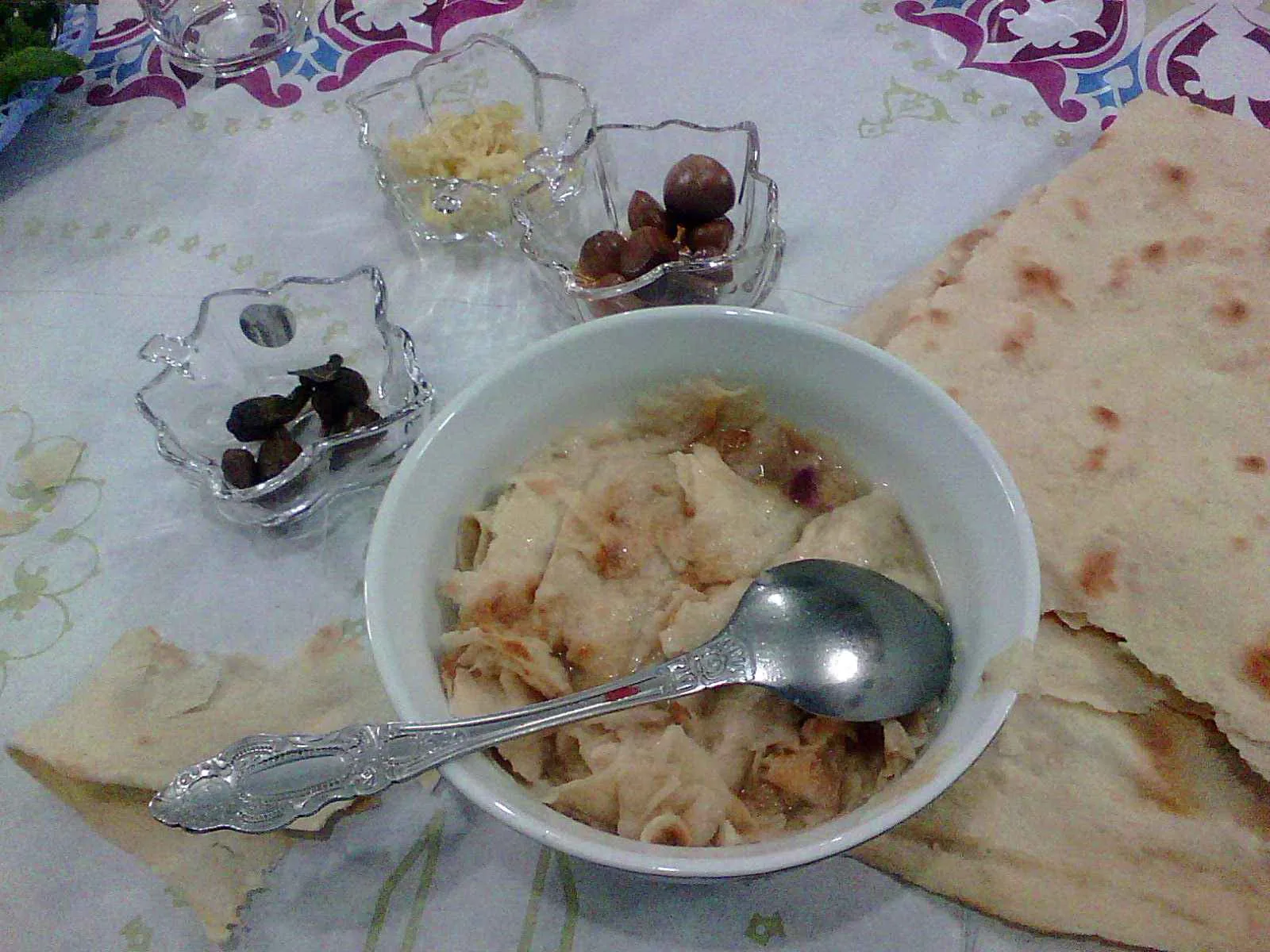
Haleem is a stew of wheat or barley and meat, and Tehran Times notes it is usually cooked in special shops in most cities. In Iran it is usually eaten for breakfast, served with cinnamon and sugar. Nozlee Samadzadeh, writing for Taste, says that in her account most Iranians leave the making to restaurants, "lining up the night before to buy their breakfast".
In an interview with Poor Man's Feast, Mojgan Ghazirad remembers it as a sweet, golden porridge with melted butter, sugar and cinnamon, served with sesame sangak her grandfather had just bought from the neighbourhood bakery. They ate it after folding the mattresses and spreading a tablecloth on the rug.
Kaleh pacheh is sheep's head and trotters, with lemon and cinnamon. It is usually eaten as a breakfast soup, especially in the cold seasons, and cooked in specialty shops. The Iranian cuisine entry says it is served from three in the morning until sometime after dawn.
Not everyone is a fan. Writing for Roads & Kingdoms, Emma Pomfret puts it this way: while rice unites the nation, "kaleh pacheh divides". Azita Houshiar of Fig & Quince calls it a traditional, "extremely occasional" early breakfast.
Before dawn in Ramadan, and three centuries ago
For those who fast during Ramadan, breakfast moves into the dark: they rise before dawn for a pre-fast meal called sahari, usually light and made of food prepared in advance. The meal that breaks the fast later in the day looks like a morning one too: a light iftar typically consists of cheese, hot bread and a cup of light tea.
The bread-and-dairy start is old. In the 17th century the traveller Gemelli Careri described a breakfast "in Azari manner" of bread and yogurt, sometimes with fruit, as Tehran Times recounts.
What did this leave out?
This is a first sketch, built from Iranian newspapers, food writers and reference works. Most of it comes from Tehran, with a little from Tabriz, Zanjan and Lahijan. It says little about breakfast in the south, the east or along the Caspian, or about how the cloth changes from one family to the next.
If you grew up in Iran, or set a breakfast cloth for an Iranian household now: what is missing? Is sangak or barbari the bread at your house, does your haleem come from a shop or your own pot, and is kaleh pacheh a treat or something you avoid? Corrections and additions are welcome, and good ones will be added to this page, with your permission and credit.
What is on your breakfast table this morning?
On peeka you pick a question and answer it with a photo. See how people around the world answer, and add yours.

Can't wait? Join the iPhone beta on TestFlight.